

Accredited by

Prerequisites
Prerequisites / what to bring
No prerequisites. A review of upper and lower limb peripheral neuroanatomy before the course is recommended; suggested reading will be sent to delegates in advance. Please wear comfortable clothing suitable for practical sessions.
Course details
A one-day, hands-on course on assessing and treating the peripheral nervous system. Learn to perform and interpret upper and lower limb neurodynamic tests, choose the right manual technique for each patient, and build active, graded exercise for nerve-related pain – grounded in current evidence.
Course overview
Nerve-related pain is common in musculoskeletal practice, often missed, and just as often over-diagnosed. Neurodynamics gives clinicians a structured way to test how the nervous system tolerates movement, and a set of manual and active strategies to treat it.
This one-day course is built on current evidence rather than old dogma. The strongest support for neurodynamic treatment is in lumbar radicular pain and cervical radiculopathy, with emerging evidence in conditions such as carpal tunnel syndrome and lateral elbow pain. Just as importantly, you will learn what the tests can and cannot tell you: a positive neurodynamic test reflects mechanosensitivity and symptom behaviour, but it does not on its own diagnose neuropathic pain, radiculopathy or nerve entrapment.
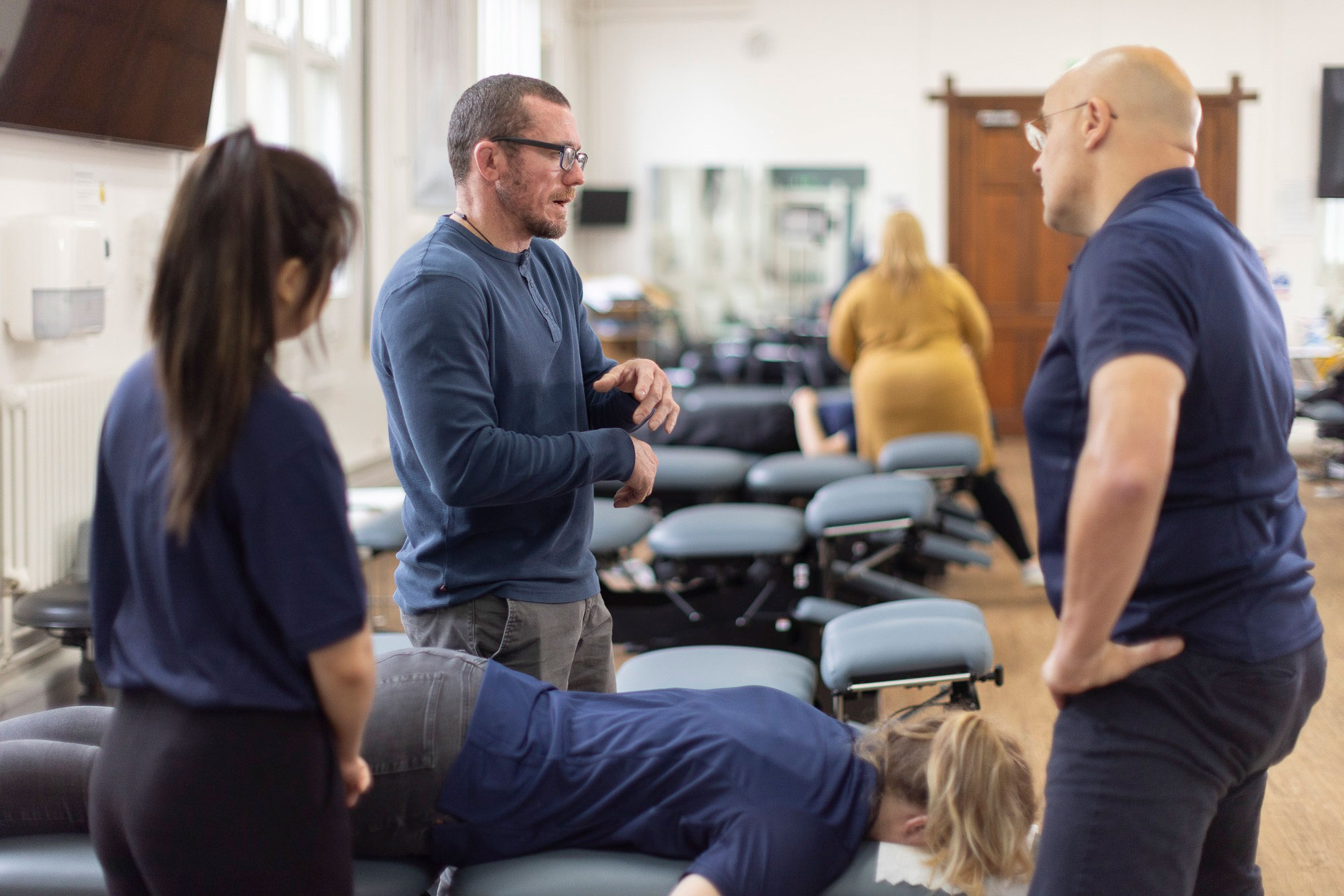
The course is predominantly practical. Short lectures are followed by supervised hands-on work in small groups, clinical case discussions, and an exercise-modification challenge in which you apply neural loading principles to everyday exercises such as squats, deadlifts, lunges and presses.
Learning outcomes
By the end of the course you will be able to:
•Explain the normal mechanical behaviour of peripheral nerves – sliding, elongation and tolerance to compression – and the pathophysiology of nerve dysfunction
•Recognise the features of neuropathic pain and the role and limits of neurodynamic testing in clinical reasoning
•Perform and interpret neurodynamic tests for the median, radial and ulnar nerves, and for the sciatic, tibial, common fibular, sural and femoral nerves
•Select and dose sliders and tensioners, with proximal or distal bias, according to the irritability of the presentation
•Apply a neurodynamic bias to manual and active techniques
•Design and progress active, graded exercise for nerve-related presentations, from acute care to return to sport
Timetable
09:00 Registration
09:30 Peripheral nerve dysfunction: pathophysiology, pain mechanisms and biomechanics – lecture
10:30 Principles of neurodynamics and the current evidence – lecture
11:00 Break
11:30 Neurodynamic assessment of the upper limb – practical
12:30 Lunch
13:30 Neurodynamic treatment of the upper limb – practical and case discussion
14:00 Neurodynamic assessment of the lower limb – practical
15:00 Break
15:30 Neurodynamic treatment of the lower limb – practical and case discussion
16:30 Active strategies: neural loading in exercise – practical
17:00 Q&A and open discussion
17:30 Close
This course is suitable for Osteopaths, physiotherapists and chiropractors, and final-year students on these programmes.
Course leader
Francesco Contiero is a Clinical Specialist Physiotherapist and Sports Osteopath based in London, working at Complete Physio and Health in Motion. His clinical work combines physical and functional assessment and rehabilitation with diagnostic and interventional ultrasound, injection therapy and independent prescribing. He trained in physiotherapy at the University of Padua and holds an MSc in Osteopathy and a PgCert in Academic and Clinical Education from the University College of Osteopathy, with further postgraduate qualifications in musculoskeletal ultrasound, independent prescribing (University of Birmingham) and soft tissue and joint injection therapy (City St George’s, University of London). He is a Fellow of Applied Functional Science (Gray Institute, USA). From 2016 to 2022 he was Lead Lecturer in Neuroscience and Clinical Neurology at UCO, and he has taught CPD courses in neurodynamics and applied biomechanics in the UK and Italy since 2019.
Why Choose HSU?
We are the only Health Sciences University in the U.K
We are constantly updating our CPD
Learn in our state of the art facilities
Our CPD is evidence-based and delivered by recognised experts in their field
Two campuses - one in Bournemouth and one in London
We offer a wide range of CPD across the year

Downloads
Funding
£160.00

Make an enquiry
Make an enquiry